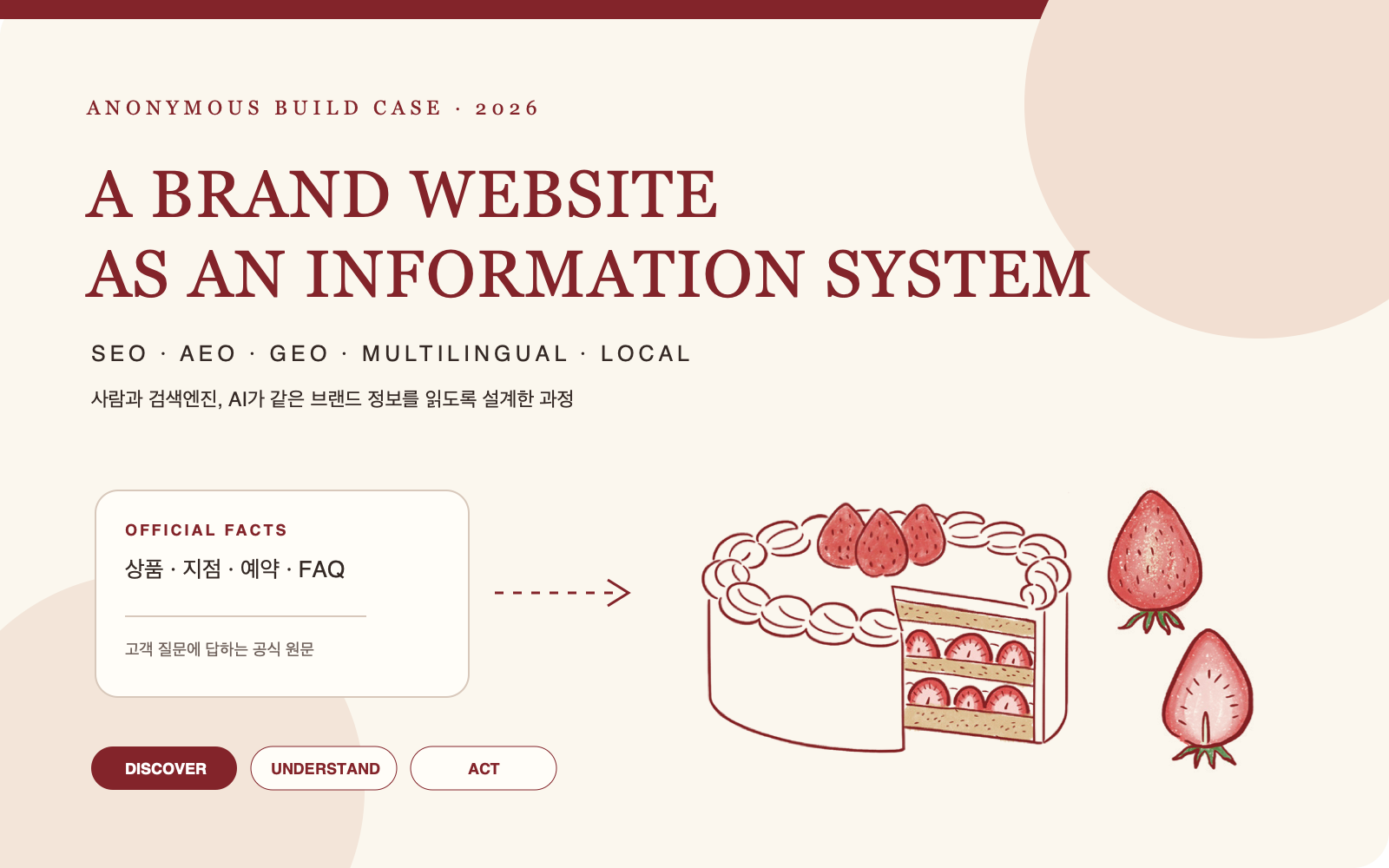
If a brand already has Instagram and a Google Business Profile, why rebuild its official website around AI search?
It started with hands-on experience.
This project was for a cake brand with several physical stores. Its established stores had been operating for years, so a reasonable amount of information appeared when people searched for the neighborhood and product names. But the newly opened store was in a different position. In an area with many international visitors in particular, customers often checked store locations, products, and reservation availability through search, maps, and AI summaries before their visit, rather than discovering the brand in person.
At first, I also considered strengthening the Google Business Profile. But a map profile alone could not consistently provide all the official information customers needed: what kinds of cakes the brand makes, how its stores differ, and how to order or make a reservation. When information on external platforms conflicted or became outdated, there was too little official source material to establish which information was current.
So I shifted the goal from 'making the website look new' to 'making people, search engines, and AI read the same brand information.' I first gathered the existing brand materials, approved images, logos, and copy, without inventing unverified prices, reviews, or operational details. On that foundation, I connected dozens of pages in Korean and several other languages, store and product information, reservation guidance, FAQs, and technical search elements into a single structure.
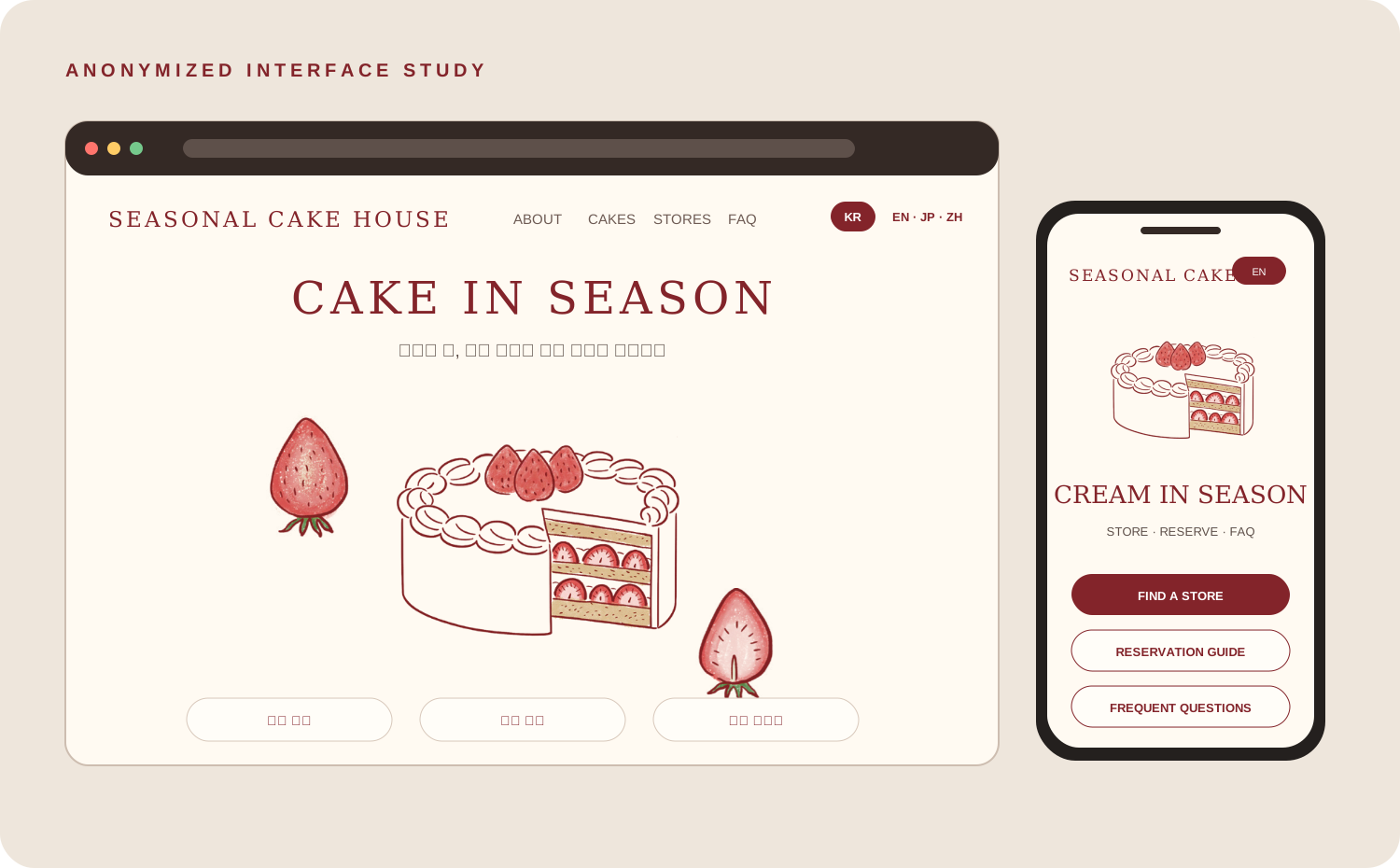
The build was not entirely smooth. Even when the language visibly changed on screen, the HTML language information stayed the same, preventing crawlers from recognizing it as a page in another language. Collapsible FAQs also appeared differently across browsers. The brand font intended for English could not display Korean properly, and the mobile search area and deployment paths needed further work. These problems made it clear that design quality and search readiness require different kinds of validation.
Key perspective
The biggest change in this case was the website's role. In the past, it might have centered on presenting the brand's atmosphere and products. Now, it needs to be an official information system that explains and substantiates what the brand is. Customer questions and answers, store and reservation details, and the reference information connecting external profiles all need to live on the website so search engines and AI can refer to them as official source material.
SEO, AEO, and GEO are not three separate jobs. SEO provides the foundation that allows pages to be discovered, crawled, and indexed. AEO structures pages to answer questions directly, such as 'How do I make a reservation?' or 'Is information available in other languages?' GEO is a way of making official facts, relationships, sources, and freshness clear so generative AI does not incorrectly mix the brand's context and evidence. Ultimately, all three begin with accurate source content.
For a multilingual site, preparing translated copy is not enough. Each language needs its own URL, the correct language must be present in the HTML as soon as the page opens, and hreflang must communicate the relationship between language versions. Google also recommends using different URLs for each language and explicitly linking language versions. If the language only appears after JavaScript changes the screen, some variants may not be discovered, so the implementation needs to be checked from an actual crawling perspective.
Still, having this structure does not guarantee search visibility or AI citations. Google's current guidance also explains that AI search features do not require a special file or dedicated schema. Basic SEO, useful source content, indexability, and structured data that matches the visible content come first. A diagnosis should therefore be used not to predict 'whether the site will definitely appear,' but as a starting point for identifying where the current website loses information and what to fix first.
7 Core Structures of an AI-Search-Ready Brand Website
Examine the full structure from official information to ongoing operations, not just one designed screen.
| Core Structure | Key Question | Elements to Check |
|---|---|---|
| Official Facts | What is the current reference information? | Brand, products, stores, reservations, and contact details |
| Page Purpose | What question does this URL answer? | Home, products, stores, reservations, about, and FAQ |
| Multilingual and Local | Can language and location information be read distinctly? | Unique URLs, lang, hreflang, and map profiles |
| Answer Content | Does it answer the customer's question with the conclusion first? | Summary, body content, FAQ, and reservation guidance |
| Crawling and Indexing | Can search crawlers discover and store it? | robots, canonical, sitemap, and internal links |
| Meaning and Evidence | Are the factual relationships on the page clear? | Structured data, sources, dates, and external channels |
| Validation and Operations | Is accuracy maintained after deployment? | Mobile QA, Search Console, and revision logs |
9 Steps Applied to the Cake Brand's Website
Although the brand name and specific stores are not disclosed, the decision criteria and validation sequence below are those used in the actual build.
-
01
Facts
I started by gathering verified brand information and assets.
I collected existing brand introductions, logos, images, and product and store information in one place and identified what was current. Rather than inventing unverified prices, opening hours, and reviews to raise a diagnostic score, I left them blank or marked them for later entry.
What to checkThe brand's representative should be able to verify every fact on the page.
Common mistakeInventing unsupported ratings and descriptions for search purposes.
What this step taught meEstablishing an authoritative reference for official facts comes before search optimization.
-
02
Questions
I organized the questions customers ask before visiting.
I gathered questions closely connected to real actions: where the store is, what cakes are available, whether reservations and pickup are possible, and whether information is available in other languages. I also separated questions that varied by language and store.
What to checkEach question should connect to an official page where the answer can be found.
Common mistakeBuilding navigation only around what the brand wants to say and overlooking what customers actually search for.
What this step taught meAEO starts not with the number of FAQs, but with the answers customers need to make decisions.
-
03
Architecture
I separated URLs according to questions and search intent.
I gave the home, about, product, store, reservation, and FAQ pages distinct purposes so they would not repeat the same explanations. Information serving different search intents became separate pages, with internal links connecting their relationships.
What to checkThe page title alone should let you explain which question that URL resolves.
Common mistakePiling all information onto one page, obscuring search intent and the location of answers.
What this step taught meWhen one URL answers one primary question, both people and search systems can understand it quickly.
-
04
Languages
I made the pages in each language genuinely discoverable.
I assigned a unique URL to each language and revised the documents so the correct lang value was present from the moment they opened. I connected corresponding language pages through hreflang and reciprocal links, and checked for discrepancies between the translated screen and how the source HTML was understood.
What to checkThe page language and core body content should be identifiable in the HTML before JavaScript runs.
Common mistakeAssuming search engines have read every language simply because the on-screen translation button works.
What this step taught meMultilingual UX and multilingual indexing require different validation.
-
05
Answers
I made important answers explicit in the body content and FAQs.
I provided store and reservation guidance as text, rather than leaving it only in images. I wrote each FAQ with a brief conclusion directly below the question and used standard HTML so anyone could open and read collapsed answers.
What to checkSomeone who searched for the question should be able to decide their next action after reading only part of the page.
Common mistakeRepeating keywords or hiding AI-only copy from people.
What this step taught meAn answer that is easy for AI to extract is usually also easy for a person to understand quickly.
-
06
Meaning
I described the visible information through structured data.
I expressed the relationships between the brand and its stores, and between pages and FAQs, in purpose-appropriate JSON-LD. Names, addresses, images, and descriptions matched the visible content, and I did not add nonexistent reviews or ratings.
What to checkEvery key property in the structured data should be verifiable on the page.
Common mistakeUsing schema as a substitute for content.
What this step taught meStructured data is not invisible advertising copy. It is a notation for explaining relationships between published facts.
-
07
Technical
I addressed crawling, performance, and mobile usability together.
I checked canonical, sitemap, robots, and internal links, and specified image alt text and dimensions. Using a static structure with less server dependence to manage page speed and maintenance costs, I also fixed errors in the mobile search area and deployment paths.
What to checkAll core pages should respond correctly at their actual deployment URLs, and key actions should work on mobile.
Common mistakeChecking only the local view without testing paths and external links at the deployed address.
What this step taught meTechnical SEO is not just a checklist. It is the distribution foundation that allows content to reach people.
-
08
Validation
I repeated browser reviews and automated checks.
I automatically checked titles, lang values, missing translations, image alt text, and internal links in documents for each language, then reviewed mobile and desktop views in actual browsers. I visually rechecked areas that automated tests can easily miss, such as FAQs, fonts, logos, and the search area.
What to checkCode checks, search diagnostics, and the actual user-facing screens should all pass.
Common mistakeMistaking a single diagnostic score for overall quality or search performance.
What this step taught meA score is a map for finding problems. Real quality comes when multiple validation results agree.
-
09
Operation
I turned diagnostic results into operational priorities.
After the build, I used diagnostics to review technology, answer content, structured data, multilingual and local information, and external signals separately. I distinguished fixable errors from items that required real data to accumulate, and documented criteria to track in Search Console and analytics tools.
What to checkDistinguish items that can be fixed this week from those that require real customer data.
Common mistakeTreating deployment as completion and stopping information updates and performance measurement.
What this step taught meAI search optimization is closer to an operating system for maintaining official information than a one-time build project.
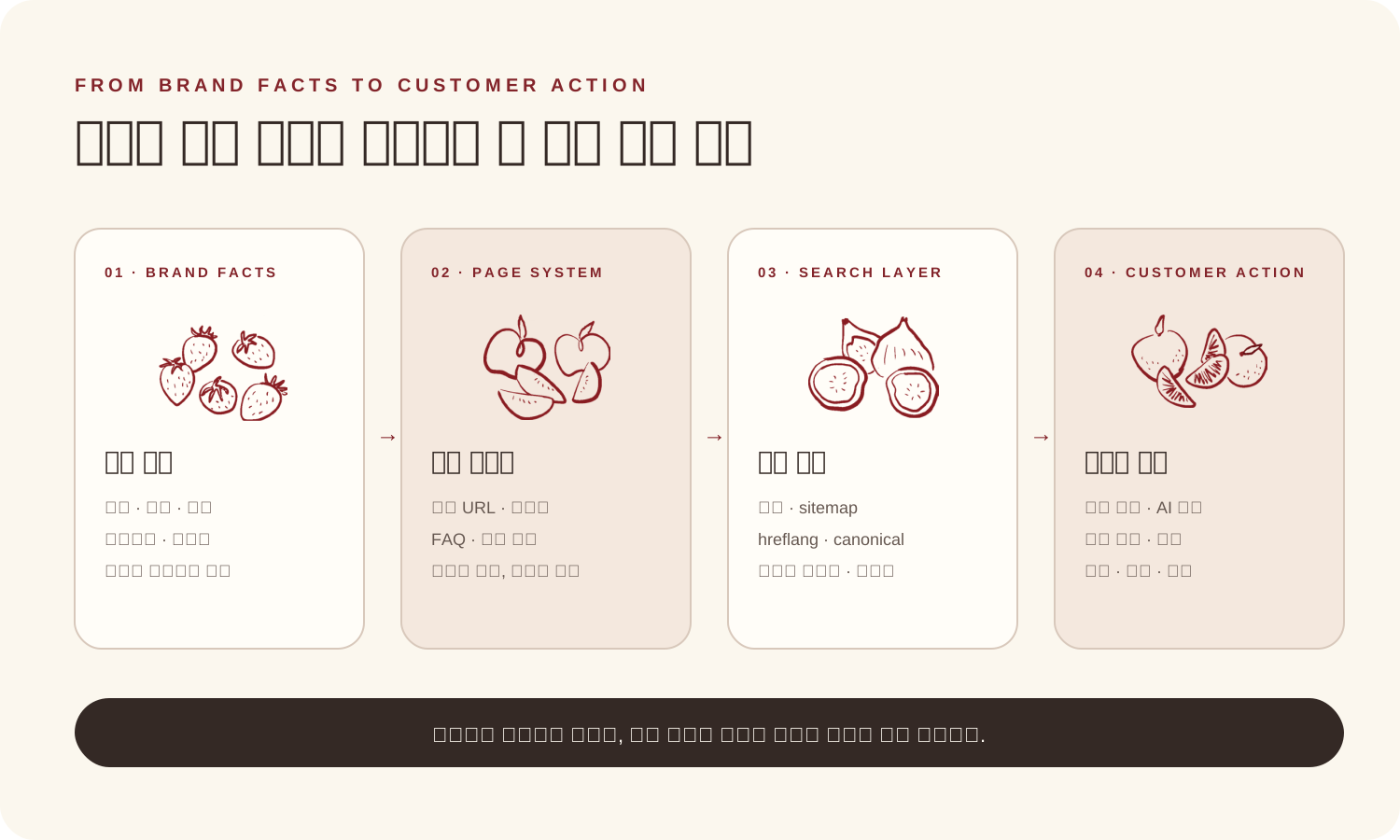
How Customer Questions Lead to Visits and Inquiries
If information is missing or contradictory at any stage, both customers and search systems have difficulty moving to the next one.
- 01Customer QuestionsProducts, stores, reservations, and languages
- 02Official Source ContentPages with a clear purpose
- 03Discovery and IndexingLinks, sitemap, and language connections
- 04Search and AI AnswersSummaries, comparisons, and supporting links
- 05Customer ActionsVisits, reservations, calls, and inquiries
Three Points Confirmed in Official Guidance
The technical wording in this article was reviewed against Google Search Central documentation as of August 2026.
AI features also begin with SEO foundations.
Indexability, useful source content, internal links, and page experience take priority over special optimizations for AI Overviews and AI Mode.
What to aim forGoogle Search Central · AI features and your website
Unique URLs and connections for each language matter.
The guidance recommends separate URLs for each language and communicating their relationships through hreflang, rather than changing only the content at a single URL based on language settings.
What to aim forGoogle Search Central · Managing multi-regional and multilingual sites
Structured data must match the visible content.
Do not put information absent from the actual page or hidden content into schema. Describe the page's primary purpose accurately.
What to aim forGoogle Search Central · Structured data guidelines
What This Case Cannot Yet Claim
Readiness immediately after a build must be distinguished from long-term search performance.
Search rankings and AI citations are not guaranteed.
Even when technical requirements are met, crawling, indexing, visibility, and citation depend on search systems and the context of the question.
What to aim forKeep monitoring actual indexing and search queries in Search Console.
It is too early to draw conclusions about traffic and revenue.
This record documents the build and validation process. Changes in traffic, reservations, and store visits should be assessed after gathering data over a sufficient period.
What to aim forRecord traffic and conversions by language, store, and page using consistent criteria.
Factual accuracy comes before diagnostic scores.
Inventing ratings or reviews may raise a score, but it can undermine brand trust and structured data quality.
What to aim forAdd information to both the page and schema only when real supporting evidence exists.
“In the age of AI search, a website is not a screen that displays a brand. It is an official information system that explains and substantiates what that brand is.”
Park Siha · SIHA
Putting it into practice
- 01Gather the brand name, product names, store names, addresses, contact details, reservation methods, and opening hours into one document to establish an official reference.
- 02Collect the questions customers ask before searching, by language and situation, and assign a page to answer each question.
- 03Check that the home, product, store, reservation, FAQ, and about pages each have one primary purpose.
- 04Design multilingual pages with unique URLs for each language, static lang values, hreflang, and reciprocal links.
- 05Provide important product, store, and reservation information as searchable body text, not just text embedded in images.
- 06Answer real customer questions in the FAQ with a brief conclusion first, and make those answers accessible to everyone on the page.
- 07Apply structured data such as Organization, LocalBusiness, Product, and FAQ as appropriate to each page's purpose, ensuring that it matches the visible content.
- 08Do not invent unverified prices, reviews, ratings, or operational information to increase a diagnostic score.
- 09Validate mobile views, actual deployment URLs, external links, and pages in each language using both browsers and automated checks.
- 10Regularly review indexing, search queries, landing pages, and inquiry behavior in Search Console and analytics tools.
A Self-Assessment for Your Brand Website
If you answer 'no' to three or more items below, consider diagnosing your information structure before changing the design.
The first screen and body text clearly explain what the brand offers and for whom.
Product, service, store, reservation, and inquiry information is current and consistent.
Each key search question has a dedicated page or a clearly defined section that answers it.
Important information is available as text on the website, not only in images or social media posts.
Multilingual pages have unique URLs for each language, correct lang values, and hreflang.
Each page's title, description, canonical, and primary image are configured for its purpose.
robots.txt, sitemap, and internal links do not obstruct crawling and indexing of core pages.
Names, addresses, services, authors, and dates in structured data match the visible content.
Menus, search, reservations, phone calls, and inquiry buttons work properly on mobile.
Indexing errors and actual search queries are reviewed regularly in Search Console.
From a Brand That Is Found to a Brand That Is Cited.
Start by checking how accurately search engines and AI understand your website. The diagnosis assesses your current state and improvement priorities across technology, content, structured data, and semantic structure.
- Crawling, indexing, and technical foundations
- Content structured to answer questions
- Consistency between schema and visible information
- Brand entities and semantic connections
Further thoughts
There is no separate, magical optimization that gets a site included in Google Search's AI features. Google Search Central currently states that existing SEO best practices remain important for AI Overviews and AI Mode, and that a page must be indexed in Google Search and eligible to appear with a snippet. Supporting files such as llms.txt can help organize brand information, but should not be treated as mandatory conditions that guarantee search visibility.
The same principle applies to structured data. JSON-LD helps explicitly describe a page's meaning, but it is not a place to add prices, reviews, or exaggerated service information that does not appear on the actual page. It is safer to provide fewer properties completely and accurately, and to check for errors after deployment using the Rich Results Test and Search Console.
For a brand with physical stores, there is no need to treat the official website and map or business profiles as competitors. The website holds the brand's reference information, the map profile connects location with visiting behavior, and social media shows recent activity and atmosphere. When names, addresses, links, and service descriptions across all three channels reflect the same facts, customers are less likely to get lost and search systems can connect the information more easily.
Ultimately, a website's strength in the age of AI search comes not from how many new terms it includes, but from creating official source content that answers customer questions accurately and consistently maintaining it in a searchable structure. A practical place to start is to diagnose the current state and fix the biggest points of information loss across technology, content, structured data, and semantic structure.